Matters
Matter registerParties and rolesJurisdictionMatter typesResponsible fee earnerStatus and stageMatter notesClosed-matter archive



For a law firm in Dubai: matters with parties and deadlines, conflict search at intake, time recorded against the rate that applies, retainers drawn down as work is done, and engagement letters generated from your own templates. Installed on the firm’s own server, one lifetime licence, unlimited users — partners, associates, paralegals and reception all get their own accounts.
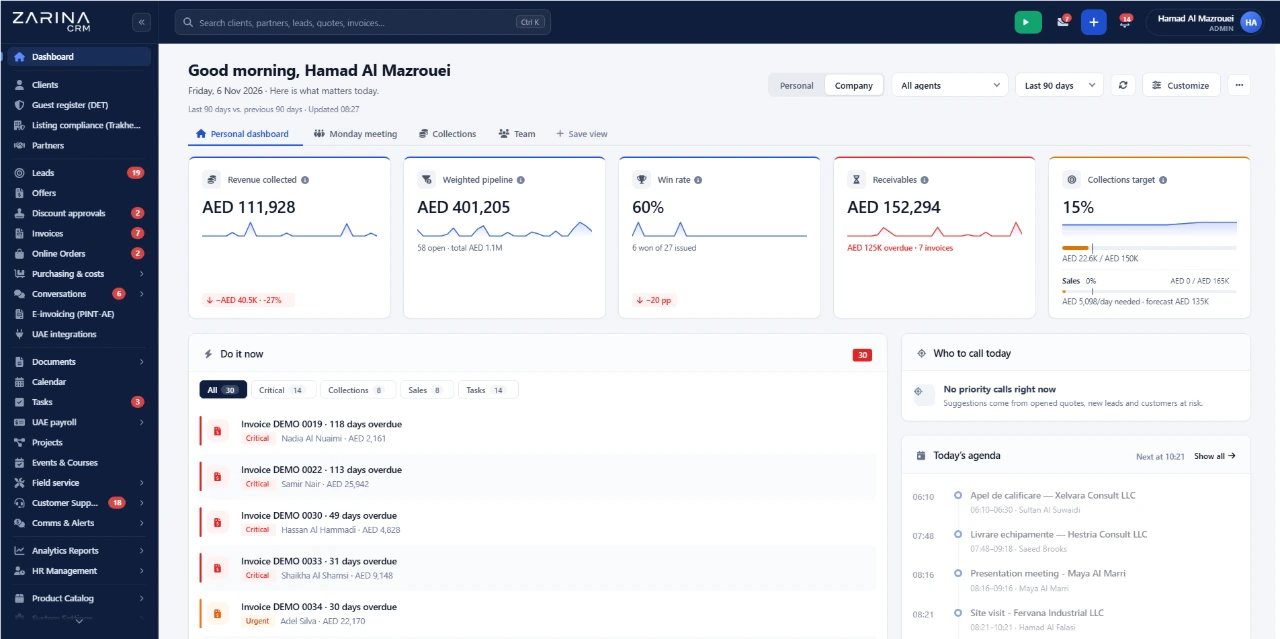
Each step writes to the same matter record, so the time you recorded, the fee arrangement you agreed and the invoice you send are the same set of facts.
The instruction arrives with its referral source recorded, and enters the pipeline with a responsible fee earner.
Every party name is checked against open and closed matters before the matter is opened; who checked and what they decided is recorded.
The engagement letter is generated from your own template, with scope and fee arrangement filled from the record.
Parties, hearings, deadlines and documents sit on the matter, with reminders on the dates that matter.
Time is posted at the applicable rate; disbursements are recorded against the matter as they are incurred.
The bill is raised against the matter in AED with VAT, drawing down the retainer where one applies.
Nothing is charged per user: every activated module runs for the whole firm, on the firm’s own server. The package is configured by module, according to what you actually use.
Law firms in Dubai search for legal case management software when they mean running the matter — parties, hearings, deadlines, documents, time — and for a legal CRM when they mean the client: where the instruction came from, who referred it, what else the client might need. Zarina CRM holds both, because the matter you are running is the client you are billing.
What it is not is a filing gateway: it does not submit anything to the Dubai Courts, DIFC Courts or ADGM e-filing portals, and it does not replace the portal accounts your firm already holds.
We prefer an honest conversation before a quote, rather than an implementation that does not solve the firm’s problem.
run matters for more than one fee earner, bill on time or on a mix of fee arrangements, need conflict checks and deadline discipline to be systematic rather than personal, and want client files on the firm’s own server rather than a vendor’s cloud.
you need a client-facing portal with per-client logins, document automation across large bundles, or integration with an existing practice-management or accounting system that must remain the master for finance. These are possible, but they need analysis before implementation rather than after.
you are a sole practitioner with a handful of matters at a time. A calendar, a time app and an invoicing tool will cost you less and serve you just as well. The system starts paying off when coordination between several people, and the risk of a missed deadline, becomes the real cost.
Integrations are configured during implementation, against accounts and systems the firm already holds.
None of these are reasons not to buy. They are the things that decide whether the first month goes well.
Running on your own server means there is no vendor cloud in the path, no copy held by us and no third-party processor between your staff and the file. But backups, user access, retention and physical security of that server are configured by the firm. Whether the resulting arrangement satisfies the professional confidentiality duties that apply to your practice is a question for your own compliance adviser — it is not something software can certify, and we will not pretend otherwise.
The system checks every party name already recorded and flags a match before the matter is opened. Whether a conflict actually exists, and whether it can be waived, remains a judgement for the firm. What the system does add is a record of who checked and what they concluded, which is what matters if the question is revisited later.
The six-month technical warranty included with the licence covers remediation of defects — things that do not work as described. New modules, new integrations and changes to how your matter workflow operates are separate development, quoted separately. We would rather say that plainly now than have it discovered at the first change request.
These do not change from one industry to the next, so they live on their own pages instead of being repeated here.
One lifetime licence, unlimited users, no monthly subscription. The full price list and what each edition includes are on the pricing page.
The database sits on hardware you control, in your own office or your own hosting account. There is no vendor cloud between your staff and your data, and no third-party processor holding a copy.
Invoices in AED with VAT handling. What the system does about the e-invoicing rules now being phased in is set out in UAE e-invoicing.
Legal is one configuration of the same platform. The full list is on Zarina CRM by industry.
Every member of the team gets their own account with their own permissions. Adding people does not change the price, which is the usual reason shared logins appear in the first place.
The demo runs on sample data, and the video tour walks through the interface. Questions that need a person go to contact.
Both sides sit in one database. Matters carry their own parties, hearings, deadlines, documents, time entries and fees, while the client side keeps enquiries, referral sources, engagement status and renewals. What it is not is a filing gateway: it does not submit anything to the Dubai Courts, DIFC Courts or ADGM e-filing portals, and it does not replace the portal accounts your firm already holds.
On your own server, inside your own office or your own hosting account. There is no vendor cloud in the path, no copy held by us, and no third-party processor between your staff and the file. Backups, user access and retention are configured by your firm. Whether that arrangement satisfies the confidentiality duties that apply to your practice is a question for your own compliance adviser, not something software can certify.
Yes. Time is entered against a matter, with its own rate per fee earner and per matter type, so the same lawyer can bill differently on a retainer client and a one-off instruction. Retainer balances are drawn down as time is posted and the remaining balance is visible on the matter rather than reconstructed at month end. Fixed fees, capped fees and milestone billing are each handled as their own fee arrangement.
It searches every party name already recorded across open and closed matters and flags a match before the matter is opened, including opposing parties and related entities. That surfaces the potential conflict; the decision on whether a conflict actually exists, and whether it can be waived, stays with the firm. The system records who checked and what they decided, which is what matters if the question is revisited later.
Unlimited. Partners, associates, paralegals, accounts and reception all get their own accounts with their own permissions, and the price does not change when the firm grows. There is no per-seat charge and no annual renewal to keep the system running, which is the usual reason firms give support staff shared logins instead of their own.
Yes, from your own templates, so client name, matter reference, fee arrangement and scope are filled from the record instead of retyped. Invoices are generated against the matter in AED, with VAT handling, and the balance is tracked per client rather than per invoice. For the UAE e-invoicing rules now being phased in, see UAE e-invoicing in Zarina CRM.
The demo runs on sample matters, time entries and bills, so you can judge the workflow rather than a feature list.
We have sent the access link to the e-mail address you entered. It usually arrives within a minute.