Zarina CRM Medical · multi-specialty clinic

Software for polyclinics, with every specialty’s chart on one shared patient record

In a polyclinic the patient moves between doctors, and the record should move with them. When each department uses its own form, its own spreadsheet or its own system, reception cannot see the whole day and doctors cannot see what a colleague found. Zarina CRM gives every specialty its own chart, on one patient record, one calendar and one invoicing flow. It is installed on the clinic’s own server, with a lifetime licence.

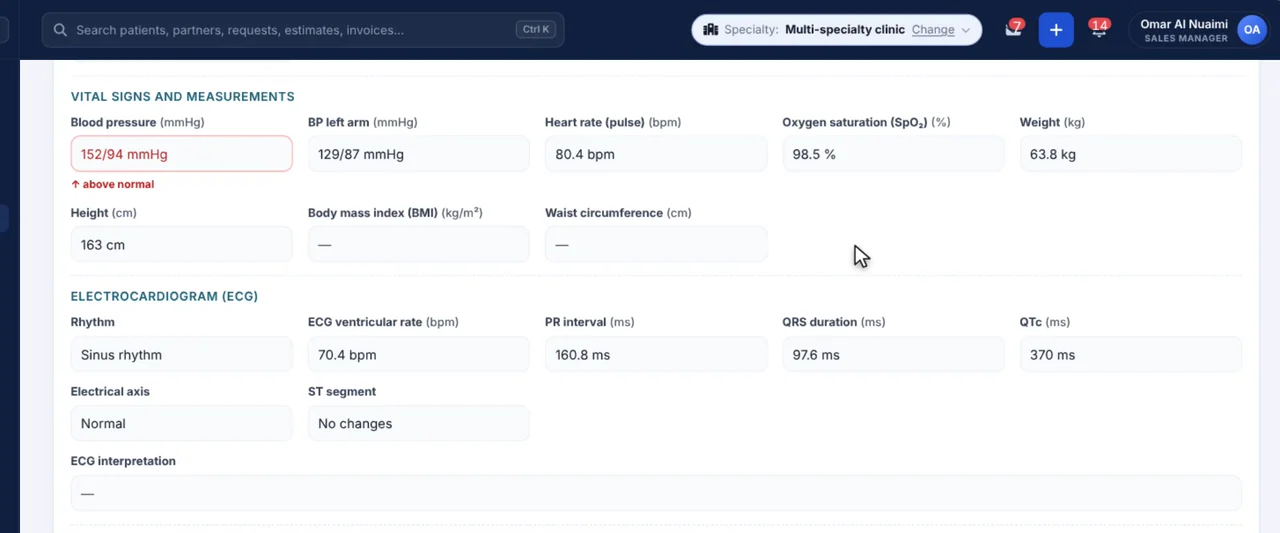
Screenshot from Zarina CRM Medical in a multi-specialty clinic: the cardiology chart with vital signs and ECG
Clinic workflow

From reception to the next specialty, in 6 steps

Every step exists as such in the application, in the order in which the data is entered.

1

Reception

One calendar for every doctor and room; the patient is booked with the right specialty.

2

One record

Insurance, chronic conditions, medication and consents are entered once, for every department.

3

The specialty chart

The doctor opens the visit on the form of their own specialty — cardiology, ENT, dermatology…

4

Signed visit

The visit is signed and locked; corrections become addenda, with author and date.

5

Referral

A referral to another specialty is issued from the visit, and the colleague sees the same record.

6

Payment and recall

Each visit is invoiced, and every specialty feeds its own check-up recalls.

One CRM, every specialty

Each doctor works on the form of their own specialty

The specialty is set per doctor. Reception does not choose forms; the doctor simply opens the right one.

23 specialty forms

From family medicine to cardiology, dermatology, ENT, ophthalmology or physiotherapy, each with its own fields.

  • Specialty set per doctor
  • The right form opens automatically
  • Your own fields with the form builder
  • New specialties added in configuration

Example: cardiology

The cardiology chart shown in the video tour, as one of the specialties of the clinic.

  • Vital signs, flagged when abnormal
  • ECG and echocardiography
  • SCORE2 risk and LDL target
  • NYHA class

One shared record

Every department writes into the same patient record, so history is not split by floor.

  • Insurance and chronic conditions entered once
  • Medication and allergies visible to all
  • Consents and documents on the record
  • Visit history across specialties
Reception and the doctors’ day

One calendar, every doctor, every room

Reception sees the whole clinic, not one department at a time.

The clinic calendar

Appointments by doctor and by room, for every specialty, on the same screen.

  • Schedule per doctor and room
  • Check-in and waiting room
  • Walk-ins
  • Rescheduling linked to the original

The dashboard

What is happening today, live, for the clinic manager and reception.

  • Appointments today, arrivals, waiting
  • No-shows
  • Doctor utilisation
  • Payments in AED

Referrals and recalls

Patients do not get lost between specialties, and each one brings them back for their own checks.

  • Internal referral from the visit
  • The same record for both doctors
  • Recalls per specialty
  • Recall list for reception
Documents and control

The paperwork comes out of the visit

  • Documents are issued from the signed visit. Medical letter, recommendation, internal referral and medical certificate are generated from what the doctor recorded.
  • A signed visit is locked. Visits are saved as drafts and locked once signed. Corrections are added as addenda, with author and date.
  • Each department is measured on the same reports. Utilisation, waiting time, new and returning patients and revenue can be read per doctor across the clinic.
  • Roles follow the organisation. Doctors, nurses, reception and management see what their role allows, with a log of who opened which chart.
The rest of the clinic

What else is included, from the Medical edition

The polyclinic setup is not a separate product. It is a configuration of the Medical edition, so you also get the rest of its modules.

Appointments and front desk

The calendar per doctor and per room, with check-in, the waiting room and walk-ins handled at reception.

  • Schedule per doctor and per room
  • Check-in and waiting room
  • Walk-ins and rescheduling
  • Reminders before the appointment

Treatment plans and estimates

Plans in phases, an estimate the patient accepts online, and service packages sold as a whole.

  • Plans split into phases
  • Estimate with online acceptance
  • Service packages
  • Linked to the patient record

Payments, VAT and insurance

Clinic payments by doctor and method, invoices with 5% VAT and the insurance claims log.

  • Invoices in AED with 5% VAT
  • Payments by doctor and method
  • Insurance claims log, CSV / XLSX export
  • Outstanding amounts per patient

Built for the UAE

Payroll and accounting needs of a clinic operating in the Emirates, not adapted from another country later.

  • WPS payroll with the SIF file
  • End-of-service gratuity
  • Connectors for accredited e-invoicing providers
  • Zoho Books, Tally and Wafeq

Patient communication

WhatsApp, requests, reviews and NPS surveys, all linked to the patient record instead of someone’s phone.

  • WhatsApp conversations on the record
  • Online requests and follow-ups
  • Reviews and NPS surveys
  • Feedback tickets with deadlines

Reports and automation

Ten ready-made medical reports, plus workflows and tasks that run without someone remembering them.

  • Appointments, utilisation, waiting time
  • New and returning patients, revenue
  • Top services, recalls and stock
  • Workflows, follow-ups and tasks
What the application does not do

It records and calculates, it does not decide

We state them explicitly, because the application is used in clinical practice.

  • It records, it does not decide. The application holds the charts, scores and documents. The clinical decision belongs entirely to the doctors.
  • It is not a hospital information system. There are no inpatient beds, operating theatre scheduling or pharmacy dispensing. It is built for outpatient polyclinics and medical centres.
  • It does not process imaging or run laboratory equipment. Results and reports are attached to the record. There is no PACS or analyser integration by default.
  • It does not calculate drug doses. Treatments are written by the doctor; we do not take on a function where an error could reach the patient.
Transparency

What to know beforehand

We prefer to be precise from the start, including about the things the application does not do.

  • It does not submit data to NABIDH, Malaffi or Riayati on its own. The application is not a connector to the emirate health information exchanges by default. If your licence requires a connection, it is built as a separate integration project.
  • Insurance claims are logged, not submitted. The claims log is exported as CSV / XLSX. Direct submission to eClaimLink, Shafafiya or a TPA portal is not part of the standard delivery.
  • Not every specialty form will match your doctors on day one. The 23 forms are a starting point. We adjust them during configuration, and you can keep adjusting them with the form builder.
  • Installation requires a server. The application runs on your side. If you have no hosting, we set it up together, but it remains yours.
Video tour · 7 minutes

See Zarina CRM Medical in a polyclinic

Reception, one calendar for every doctor, the shared patient record, a specialty chart shown with a cardiology visit, documents and payments – on real screens of the Medical demo, with English subtitles.

Polyclinic software – Zarina CRM video tour
7:25 running time14 chaptersSubtitles in EnglishPublished on 11 November 2026
Where you are today

If every department runs its own system

The problems below are not hypothetical. They are the reasons clinics look for software.

One system per department

Cardiology has its own spreadsheet, dermatology its own software, and reception copies data between them.

Every specialty writes into one patient record.

The referral on paper

The patient is sent to a colleague upstairs, who starts the history from zero.

The referral is issued from the visit, and the colleague sees the same record.

Nobody sees the whole day

The manager learns about no-shows and idle doctors at the end of the month.

The dashboard shows arrivals, waiting and utilisation, live.

Licensing model

A lifetime licence, not a monthly subscription

The polyclinic setup is part of the Medical edition. It is paid once, installed on your side and remains the clinic’s.

  • Unlimited users. You do not pay per doctor, nurse or receptionist. The number of accounts does not change the price.
  • The platform is activated by module. Choose the package that covers what you use, with unlimited users.
  • Prices and packages are published. You will find them on the pricing page, with what each option includes.
  • Updates do not lock you in. An existing installation receives new versions without needing a new licence.
Implementation

What you get when you sign the contract

Installation on your server

We install the application on the clinic’s hosting and configure it around the real workflow, not a generic one.

Your specialties configured

We activate the specialties you run, assign them to doctors and adjust the forms with your teams.

Team training

Reception, nurses and doctors are trained on their own roles, not on every screen of the application.

Fit

Who it is for and who it is not for

It is for

Polyclinics and medical centres in the UAE running several outpatient specialties that want one patient record and one calendar, on their own server.

It is for

Groups growing from one specialty to several, who do not want a new system for every new department.

It is not for

Hospitals needing inpatient, theatre or pharmacy modules. Those are not part of the application.

Security

Where the data lives and who is responsible for it

A polyclinic holds the health data of every department. Its place is on the clinic’s server, not with us.

  • Installation is on your side. The application runs on the clinic’s server, so patient data does not pass through our infrastructure — and stays in the UAE if your server is there.
  • Health data is handled as health data. Sensitive fields are encrypted, and every opening of a chart is written to the access log.
  • Access is by role, with a log. Doctors, nurses and reception see only what their role allows, and you can see who opened what.
  • Patient data requests are handled in the application. Consents, and requests to access or correct personal data under the UAE PDPL, are recorded on the patient record.
Frequently asked questions

Answers about the polyclinic setup

Is the polyclinic setup a separate product?

No. It is the Medical edition with several specialties active at once, the specialty set per doctor. You get the whole Medical edition.

How many specialties can run at the same time?

All 23 delivered specialty forms can be active together. Each doctor works on the form of their own specialty.

Do doctors see each other’s notes?

They work on the same patient record, within the permissions of their role. Access to charts is logged.

How do referrals between specialties work?

An internal referral is issued from the signed visit, and the receiving doctor opens the same patient record.

Can reception see every doctor’s schedule?

Yes. The calendar shows every doctor and room, with check-in, waiting room and walk-ins.

Is it a hospital system?

No. It is built for outpatient polyclinics and medical centres. It does not include inpatient, theatre or pharmacy modules.

How many users can we have?

Unlimited. The licence is not paid per user, so adding doctors or departments does not change the price.

How do I see the application before ordering?

Ask for demo access. You receive a personal link to the Medical edition test installation, set as a multi-specialty clinic.

Other medical profiles

The same solution, configured for another practice

Each specialty also has its own page. If you run a single-specialty practice, go straight to your own version.

Medical CRM

The complete solution: patient file, appointments, invoicing and portal, for a practice or clinic.

Dental CRM

The dental chart, the per-tooth treatment plan and the estimate that comes out of it.

Dermatology CRM

Skin examination, dermoscopy, severity scores and photos kept in the visit.

Ophthalmology CRM

Examination for each eye, the optical prescription and the lens order tracked through to handover.

All specialities

The 23 configured specialities, each with its own form, demo and video tour.

No monthly subscription

Every specialty, one patient record, on the clinic’s server

We install Zarina CRM on your side, activate the specialties you run and train the team. From that moment on, the application is an asset of the clinic, not a monthly expense.