Referral and history
Why the patient came and what happened before, recorded in fields.
- Referral diagnosis
- Body region
- History of present illness
- Surgery date and type



Rehabilitation is a series of sessions, and the value is in the series. When the assessment is on paper and the sessions are ticked in a notebook, nobody can show the patient — or the insurer — how far they have come. Zarina CRM keeps the referral, the functional assessment, the rehabilitation plan and what was done at every session on one record. It is installed on the clinic’s own server, with a lifetime licence.
Every step exists as such in the application, in the order in which the data is entered.
The referral diagnosis, body region and the surgery date and type, if there was one.
VAS pain, range of motion, muscle testing, posture, gait and the DASH functional score.
Goals, modalities, the number of sessions recommended and their frequency.
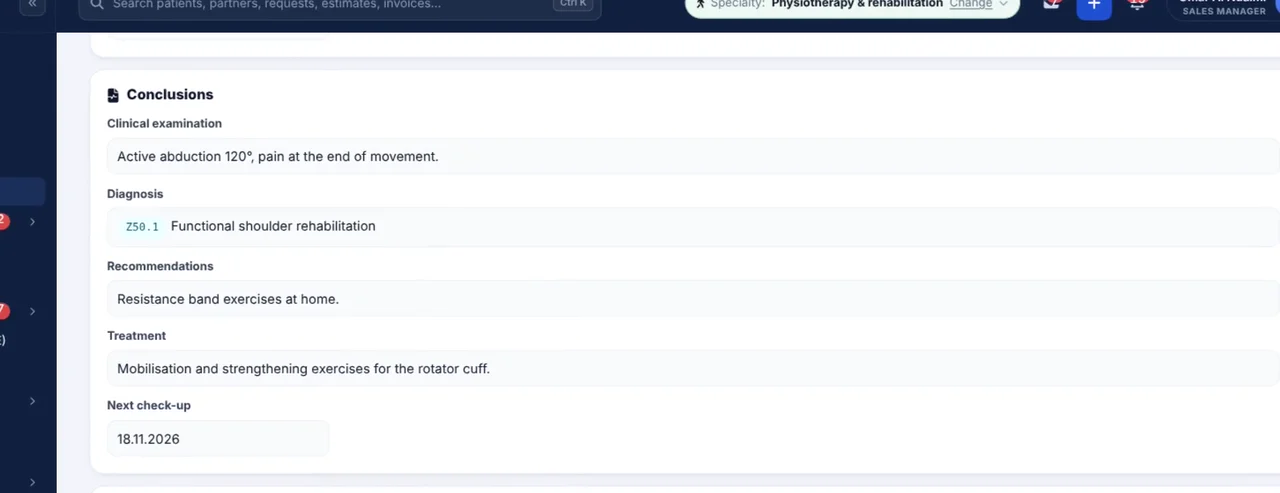
At every session: the treatment delivered, tolerance and progress since the last one.
The same measures again, so the change is visible in numbers, not impressions.
Sessions and packages are invoiced, and the next check-up date feeds the recalls.
The form is built for rehabilitation: it measures function, not only symptoms.
Why the patient came and what happened before, recorded in fields.
The measures you return to at every re-assessment.
How the condition affects daily life, as a score that can be compared.
The plan says what should happen; the session record says what did.
Goals and modalities agreed at the start, with the number of sessions.
Each session is recorded with what was done and how the patient responded.
Sessions sold as packages, and patients brought back for re-assessment.
The physiotherapy profile is not a separate product. It is a configuration of the Medical edition, so you also get the rest of its modules.
The calendar per doctor and per room, with check-in, the waiting room and walk-ins handled at reception.
Plans in phases, an estimate the patient accepts online, and service packages sold as a whole.
Clinic payments by doctor and method, invoices with 5% VAT and the insurance claims log.
Payroll and accounting needs of a clinic operating in the Emirates, not adapted from another country later.
WhatsApp, requests, reviews and NPS surveys, all linked to the patient record instead of someone’s phone.
Ten ready-made medical reports, plus workflows and tasks that run without someone remembering them.
We state them explicitly, because the application is used in clinical practice.
We prefer to be precise from the start, including about the things the application does not do.
Appointments, the referral, VAS and range of motion, the rehabilitation plan, sessions and payments – on real screens of the Medical demo, with English subtitles.
The problems below are not hypothetical. They are the reasons clinics look for software.
At discharge, nobody can find the range of motion measured on day one.
The assessment is on the record, with the same fields every time.
The patient paid for ten sessions; the notebook shows eight.
Every session is recorded with treatment and progress.
Halfway through the plan the patient disappeared, and nobody noticed.
The next check-up date puts them in the recall list.
The physiotherapy profile is part of the Medical edition. It is paid once, installed on your side and remains the clinic’s.
We install the application on the clinic’s hosting and configure it around the real workflow, not a generic one.
We adjust the assessment fields, scales and session packages to how your therapists work.
Reception, assistants and clinicians are trained on their own roles, not on every screen of the application.
Physiotherapy and rehabilitation clinics that want assessments, plans and sessions on one record, on their own server.
Clinics working with orthopaedic surgeons and sports medicine, where referrals and progress reports matter.
Anyone looking for an exercise video library or wearable integration. Those are not part of the application.
A clinic’s records are health data. Their place is on the clinic’s server, not with us.
No. It is a configuration of the Medical edition, with the physiotherapy chart activated. You also get the rest of the Medical edition’s modules.
VAS pain, range of motion, muscle testing, posture, gait and the DASH functional score, plus the referral diagnosis and surgery details.
Yes. Every session records the treatment delivered, the patient’s tolerance and the progress since the last session.
Yes. Service packages, plans and estimates with online acceptance are part of the Medical edition.
Yes. The form builder lets you add sections, fields, scales, lists and calculations yourself, per specialty.
On the clinic’s server. The application is self-hosted, so data does not pass through our infrastructure.
Unlimited. The licence is not paid per user, so adding clinicians or front-desk staff does not change the price.
Ask for demo access. You receive a personal link to the Medical edition test installation, set to physiotherapy.
The Medical CRM is configured by speciality. If you do not work only in physiotherapy, go straight to your own version.
Special tests, imaging, injections with batch numbers and the physiotherapy referral.
Every specialty with its own chart, on one shared patient record.
Vital signs flagged when abnormal, prevention, screening and chronic care.
GCS, cranial nerves, MRC power, MMSE and EDSS, with EEG and EMG results.
The complete solution: patient file, appointments, invoicing and portal, for a practice or clinic.
The 23 configured specialities, each with its own form, demo and video tour.
We install Zarina CRM on your side, configure the assessment and packages and train the team. From that moment on, the application is an asset of the clinic, not a monthly expense.
We have sent the access link to the e-mail address you entered. It usually arrives within a minute.
