

Recruitment and the careers page, with the candidates in a single flow
The vacancies are published on a careers page hosted on the company domain, the applications enter the system directly, and every candidate moves through clear stages, with an owner and a deadline. The interviews are booked in the team calendar, and the data of rejected candidates is deleted automatically when the retention period expires.
From $2,900one-time payment, no monthly subscription- A careers page of your own
- Applications in a flow of stages
- Interviews booked
- An answer for every candidate
- Automatic deletion at expiry
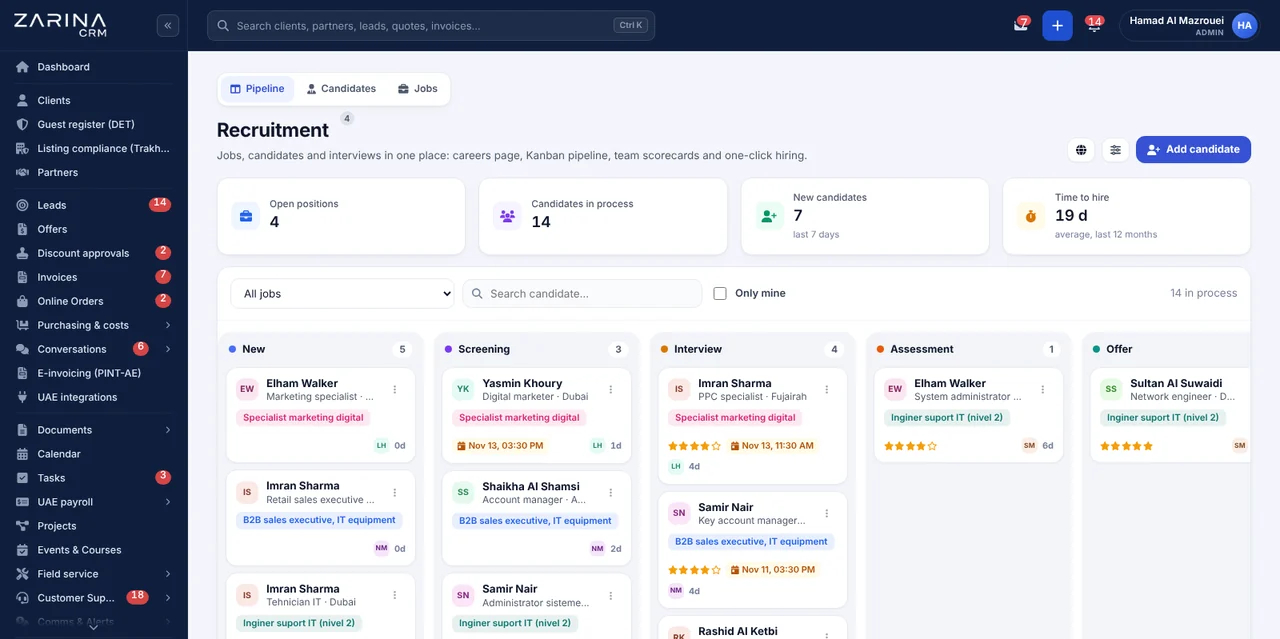
Recruitment in the CRM: a careers page and a selection flow. The vacancies are published on a careers page hosted on the company domain, the applications enter the system directly, and every candidate moves through clear stages, with an owner and a deadline. The HR and recruitment package. A lifetime licence, installation on the company server and unlimited users.
Works together with: HR and attendance, Form builder, Events and registrations.
The situation today, when recruitment is kept in a mailbox
An unorganised recruitment process costs twice: vacancies filled late and good candidates lost.
- The applications pile up in a mailbox The CVs arrive as attachments, at a general address. Nobody has the full picture of the candidates for a vacancy.
- Nobody knows which stage each candidate is at Without a visible flow, the same person is contacted twice or, more often, by nobody.
- Good candidates are lost through delay In periods with a staff shortage, a delay of a few days means losing the candidate to a faster employer.
- There is no history of earlier applications Somebody who applied a year ago and was promising is not found again when a similar vacancy opens.
- The personal data is left with no clear regime The CVs stay in mailboxes and on devices, with no retention period and no real way of deleting them on request.
- The efficiency of recruitment cannot be assessed How many days it takes to fill a vacancy, which sources the good candidates come from: information that exists nowhere.
Recruitment managed in the same system as the rest of the company
The module covers the route: vacancy published, application, selection stages, interview, decision.
Vacancies with a full description
Every vacancy has a record of its own.
- Title, department and location
- Description and requirements
- Status: open, on hold, filled
- A recruitment owner
A public careers page
The adverts are published on the company domain.
- An address of its own, on your installation
- A list of open vacancies
- An application form with an attachment
- Available in several languages
Applications in a flow of stages
The selection becomes a visible process.
- Configurable stages per vacancy
- The candidate assigned to an owner
- Assessment notes
- A complete history of the stages
Interviews booked
The meetings enter the team calendar.
- A booking with participants
- An online meeting, if it is configured
- Automatic reminders
- The outcome recorded after the interview
Communication with the candidates
The answer is sent, not postponed.
- An automatic confirmation on application
- Reply templates per stage
- An interview invitation
- An answer to the rejected ones too
A reusable candidate pool
Earlier applications become a resource.
- Search by skills and experience
- Earlier applications visible
- Tags on profiles
- Contacting them for new vacancies
What changes with the first vacancy published from the system
The direct effects of recruitment having a flow rather than a mailbox.
Vacancies filled faster
The response time drops significantly.
- Applications visible immediately
- An owner set per vacancy
- An alert on new applications
- Stages with deadlines
No candidate ignored
Every person receives an answer.
- An automatic confirmation on applying
- Templates for every stage
- An answer on rejection too
- A professional employer image
Selection decisions documented
The choice can be justified.
- Assessment notes per candidate
- Assessments from several interviewers
- Comparable criteria
- A history of the decision
A candidate pool of your own
The next recruitment starts from something.
- Profiles kept lawfully
- Search by skills
- Contacting them for similar vacancies
- Lower recruitment costs
Compliance on personal data
The risk of keeping CVs indefinitely disappears.
- Consent recorded
- A retention period configured
- Automatic deletion at expiry
- Deletion on request
The efficiency of the process, measurable
Recruitment becomes comparable over time.
- Days until the vacancy is filled
- Applications per vacancy
- The sources that produce hires
- The interview attendance rate
The route of an application, step by step
The same flow for a junior role and for a management position.
- 1
The vacancy is published
The description, the requirements and the selection stages are filled in. The advert appears on the public careers page, at an address of its own on the company domain.
- 2
The candidate applies
The form collects the details you set and the attached document. The notice on data processing is part of the form.
- 3
The application enters the flow
The candidate appears in the first stage, with an owner assigned. If they have applied before, the earlier applications are visible immediately.
- 4
The selection advances through the stages
Every stage has an owner and a deadline. The assessment notes stay on the candidate, not in private messages between colleagues.
- 5
The interview is booked
The meeting enters the participants’ calendar, with a reminder. If it is online, the link is generated and sent to the candidate.
- 6
The decision is communicated
The candidate selected receives the offer, the others receive an answer. The data of those rejected is kept only for the period configured.
Recruitment and careers, in short, inside the application
The careers page: the first contact with future employees
For many companies, the careers page is the most visited page after the contact page.
Hosted on your own domain
The candidates apply to you, not on a portal.
- An address on the company domain
- Your own visual identity
- No fee per application
- No dependence on an external portal
A form with documents attached
The application is complete from the first step.
- Configurable fields
- Attaching documents
- File types checked
- Protection against automated submissions
A notice about the data
Compliance starts from the first contact.
- The notice text displayed
- Consent recorded on applying
- The retention period stated
- An option to delete on request
Several languages
Useful for companies recruiting internationally.
- Adverts in the languages configured
- The form translated
- Communications in the candidate’s language
- Including languages written right to left
The selection stages, configured on your own process
A flow imposed by software does not get followed. The stages are defined according to how you actually hire.
- 01
The stages are defined per vacancy
A production role does not have the same process as a management position. The stages are configured separately where that is needed.
- 02
Every stage has an owner
Moving from one stage to the next does not depend on somebody taking the initiative. The owner is set, and delays become visible.
- 03
The assessments stay on the candidate
The interviewers’ impressions are recorded in a structured form, not passed on verbally. The final decision has a documented basis.
- 04
Rejection is a stage, not an omission
The rejected candidate receives an answer, generated from a template. That is the difference between a company people recommend and one they avoid.
- 05
Duplicates are handled correctly
Somebody who applies twice for the same vacancy does not create two records. The verification link is sent by email.
- 06
The history stays with the company
When the person who did the recruiting leaves, the process and the assessments stay in the system, not in their mailbox.
What works without daily intervention in the recruitment module
Mechanisms that cut the administrative work and protect the employer image.
A confirmation on applying
The candidate knows the application arrived.
- Sent immediately
- Configurable text
- Information about the process
- No manual intervention
Templates per stage
The communication becomes consistent.
- An interview invitation
- A request for documents
- A rejection answer
- A job offer
Interview reminders
Attendance at the interview goes up.
- A reminder to the candidate
- A reminder to the interviewers
- An online meeting link
- Simple rescheduling
Alerts on deadlines
The candidates do not get stuck in a stage.
- A warning when the deadline is passed
- A notification to the owner
- A list of applications waiting
- A report on blockages
Automatic clean-up of the data
Compliance does not depend on discipline.
- Deletion when the period expires
- It includes the attached records
- Clean-up from notifications and the calendar
- A log of the operations
Periodic reports
Management sees the position without asking.
- The open vacancies and where they stand
- Days until a vacancy is filled
- Applications by source
- Sent automatically by email
The candidates’ data, handled under a special regime
A rejected candidate remains a person whose data the company processes. The module handles that situation explicitly.
- Access limited to recruitment The applications are consulted by the roles involved in recruitment. They are not visible to the whole company.
- Consent recorded The moment and the content of the notice stay registered, together with the application.
- A retention period configured The data of candidates not selected is deleted automatically when the period set by the company expires.
- Complete deletion, not partial The clean-up includes the attached documents, the assessment notes, the bookings and the notifications, not only the main record.
- The documents are protected The attachments are served only to users with the right, through checked links, not through public addresses.
- Data on the company server The applications stay in your own installation. We do not use an external recruitment portal and there is no copy at a provider.
What needs to be prepared to put the recruitment module into service
We do the configuration ourselves at implementation, on the real hiring process.
The recurring vacancies
The adverts are reused, not rewritten.
- Vacancies opened frequently
- Descriptions and requirements
- Department and location
- Prepared at implementation
The selection stages
The flow follows real practice.
- Stages per type of vacancy
- An owner per stage
- Committed deadlines
- Reviewable later
The communication texts
The messages are written once.
- Confirmation, invitation, rejection
- In the languages needed
- The company’s signature
- A tone agreed internally
The data retention policy
Settled before the first application.
- The retention period
- How speculative applications are handled
- The procedure for deletion on request
- Agreed at implementation
An email server configured
Communications go out through your own server.
- An active sending account
- A domain with its reputation configured
- A log of what was sent
- Checked at implementation
The team calendar
The interviews enter the real schedule.
- A connected calendar, if you want one
- Participants and availability
- Online meetings, optional
- Configured at implementation
The limits of the recruitment module, stated explicitly
The module manages recruitment. It does not publish adverts on portals and does not run payroll.
- It does not publish on job portals automatically The advert is published on your own careers page. Distributing it on external portals is done by you, with the link to your own page.
- It is not payroll software The module covers recruitment and, through the human resources module, employee administration. The salary calculation stays in the dedicated software.
- It does not assess applications automatically We do not assign automatic scores and do not filter candidates through algorithms. The selection stays a human decision, documented.
- It does not generate assessment tests The professional tests are administered with your own tools, and the results are recorded on the candidate.
- It depends on the mail server If your mail server is unavailable, the communications wait. The applications keep being registered.
- It does not replace the onboarding process Receiving the new employee is managed through the human resources module and through tasks, not in this module.
When this module makes sense and when it does not
We prefer to say from the start in which situations the module is not worth its cost, so the sales conversation does not begin with the wrong expectations.
It makes sense if
The situations in which the module pays for itself quickly.
- You recruit constantly and the applications arrive by email
- Nobody knows which stage each candidate is at
- You want a careers page of your own, tied to the CRM
- Several people assess the same candidates
It does not make sense if
The situations in which we recommend not buying it now.
- You hire once every few years
- You work exclusively with a recruitment agency
- The applications come through direct referral
- You have nobody to keep the process up to date
Which package the recruitment module belongs to
The module is licensed together with personnel administration.
The human resources package
It contains recruitment, employee administration, leave and attendance.
What every package includes
Every package includes users and roles, clients and contacts, a lead and sales pipeline, custom fields and 15 interface languages.
Together with human resources
For the full employee journey, the HR and attendance module is recommended.
Pricing and configurations
Package composition and prices by edition are on the pricing page.
Companies that have trusted Zarina CRM


Recruitment and careers: what it costs and what you get
You pay once. Everything that follows is written here, not in hidden conditions.
The Recruitment and careers module is included in the BUSINESS package: $4,640, paid once, for the whole company.
The same CRM, in 3 packages. Each package includes everything in the one before it:
- STARTDoes not include this module$2,900
- PRODoes not include this module$3,480
- BUSINESSIncluded$4,640
One-time payment, unlimited users. What each package contains is on the pricing page.
What you pay over time for a subscription CRM
Over 3 years, the subscription costs $9,000; the Zarina BUSINESS licence costs $4,640, once.
An indicative comparison: enter the subscription price you pay now. The licence does not grow with the number of users.
What you get
- A lifetime licence, with no subscription and no per-user charge
- Unlimited users, on the same licence
- 6 months of warranty on correct operation: fixing errors and inconsistencies
- Implementation, configuration and team training, included in the price
- The licence is verified locally, on your own server: the application does not depend on our servers to work
How long it takes and what is needed
- 48 hours in the standard configuration; up to 14 working days with customisation around the company’s workflow
- Your own server or web hosting with cPanel, with an SSL certificate
- PHP 7.4 or newer (8.x recommended) and MySQL / MariaDB
- The PHP extensions mysqli, json, mbstring; curl, gd and zip for integrations, PDF and exports
- One cron task, for reminders and automations
Where data lives
- The data stays on your server and does not pass through ours
- Roles and rights per user, two-factor authentication
- An audit trail and limits on login attempts
- Consents and data subject requests, managed in the application
- Digitally signed updates and backups from the application
Do you have a question about Recruitment and careers?
We answer in writing, with the exact price for your configuration.
Questions about the recruitment and careers module
Is the careers page hosted at your end?
Can I also publish on the job portals?
What happens to the CVs of rejected candidates?
Can a candidate apply for several vacancies?
Who has access to the applications?
Can online interviews be booked?
Does the module assess the candidates automatically?
Can I search the earlier applications?
Does the form work in several languages?
Does it replace payroll software?
Get the complete product sheet by email
A six-page document with everything you need to know before a sales conversation. No obligation and no sales call.
- All the modules of the platform and the package that includes each one
- The features and modules of the edition you choose, plus available integrations
- Full pricing and what it includes: installation, training, data import, warranty
- The native integrations available and the situations where the platform is not a good fit
Take control of your operations, once
We install Zarina CRM on your hosting, configure it around your own workflow and train your team. From that moment on, the application is an asset of your company, not a recurring expense.